Gaze-adaptive VR streaming
Preserving visual detail where people look while reducing the pixels sent to a VR headset.
- Discipline
- VR & XR
- Context
- Doctoral research · ACM Multimedia 2025
- Research programme
- 2024–present
- Support
- Research Council of Finland
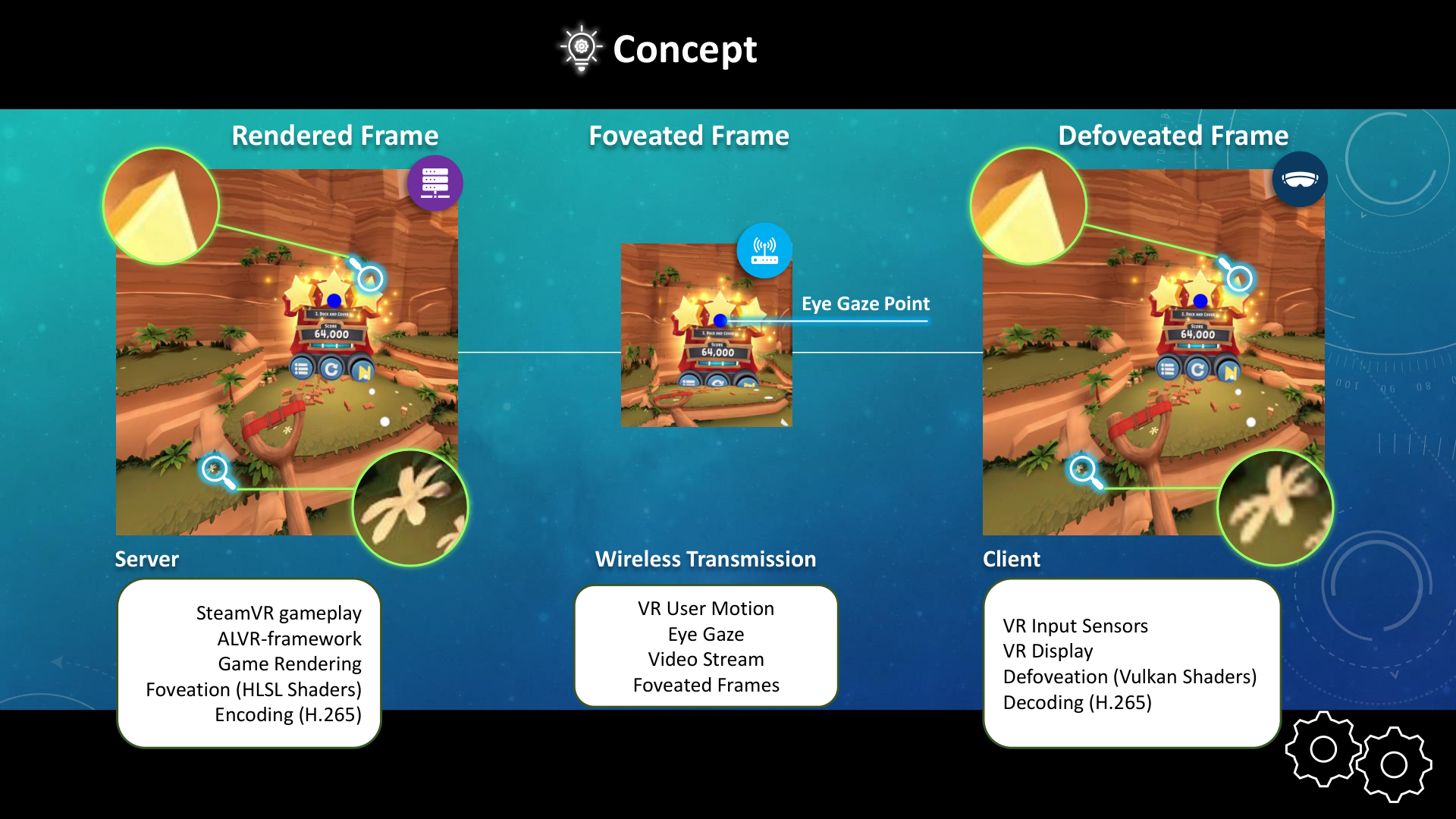
Server-side spatial compression preserves detail near the gaze point; the headset reconstructs the full-resolution image.
3 images · Select a thumbnail to explore. Original project photographs and illustrations.
The work
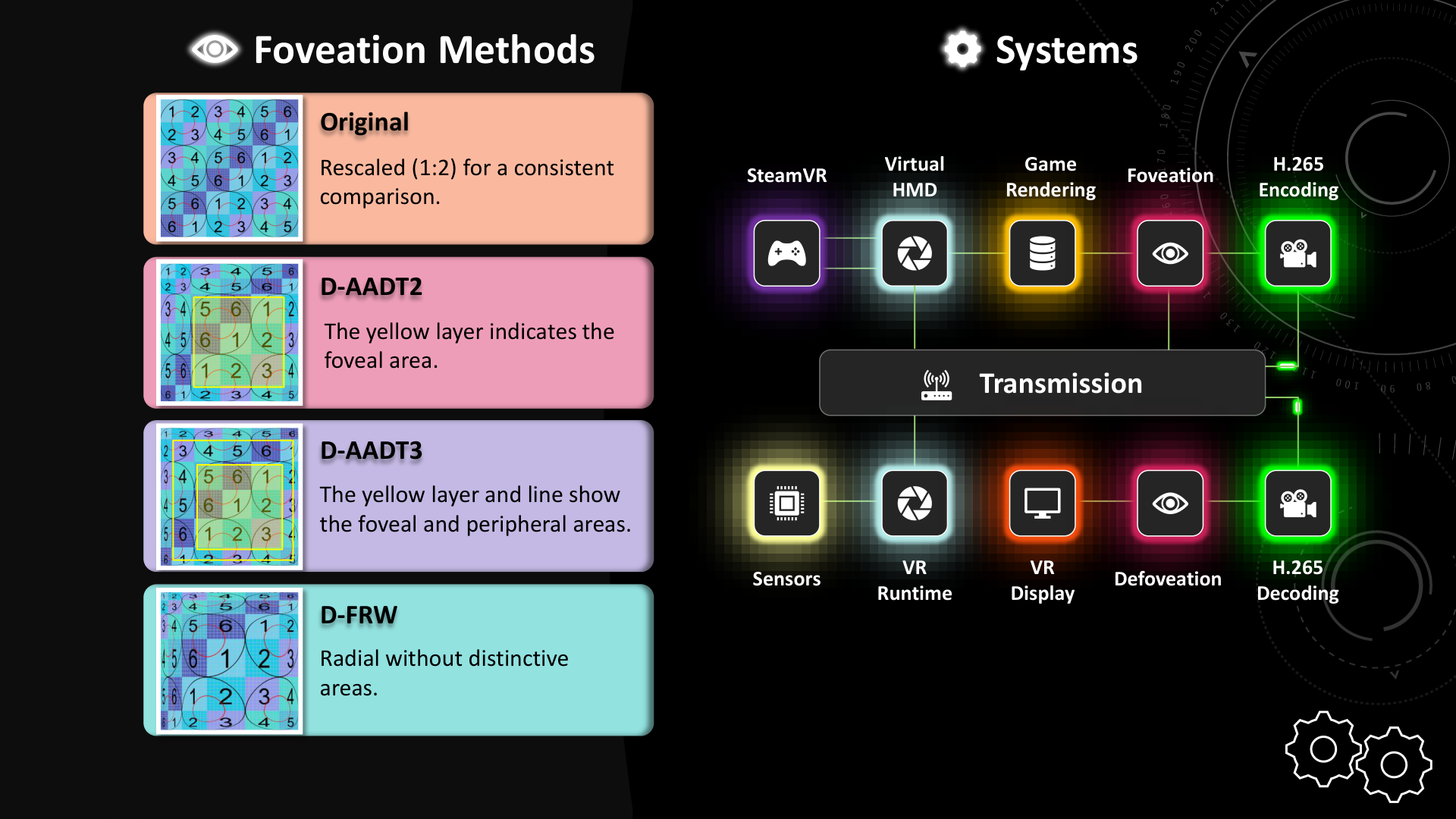
I implemented gaze-adaptive spatial compression in ALVR for remotely rendered VR. The server keeps more detail around the viewer’s gaze and compresses the periphery before video encoding. The headset reconstructs the image using matching parameters. This work compares three dynamic methods with their static counterparts and connects graphics implementation with perceptual evaluation.
Project contributions & outcomes
- Integrated D-AADT2, D-AADT3, and D-FRW into the ALVR research platform alongside static baselines.
- Implemented server-side HLSL foveation and client-side Vulkan shader reconstruction with synchronized gaze updates.
- Connected SteamVR rendering, H.265 encoding and decoding, and eye-tracking input in an end-to-end streaming system.
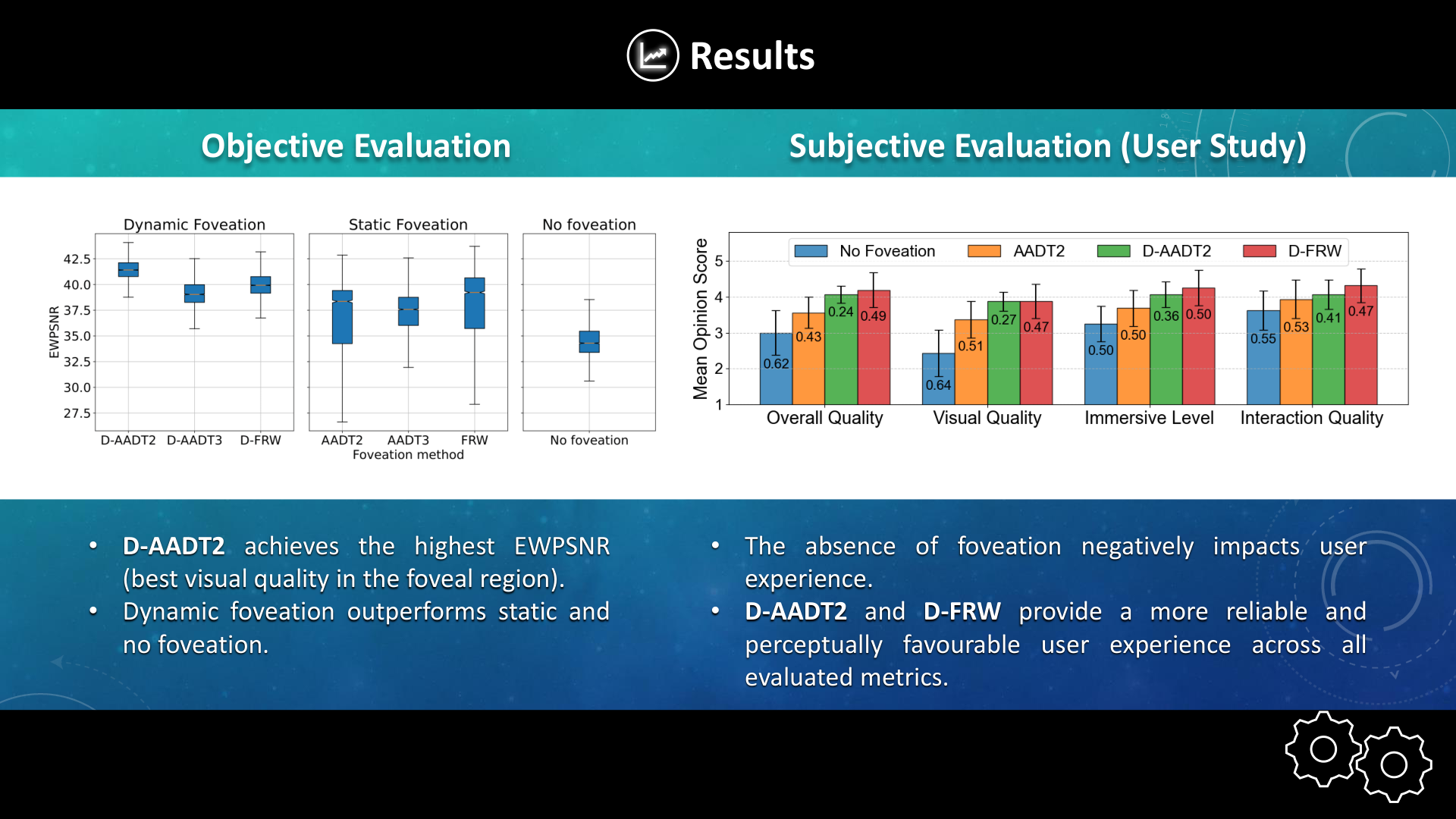
- Evaluated visual quality using eye-weighted PSNR and FovVideoVDP, and contributed to the collaborative subjective evaluation.
Tools & focus
What the study found
- The evaluated system supported native 72 FPS operation with real-time gaze updates.
- Dynamic methods generally improved visual quality over static foveation, with content-dependent exceptions such as centrally focused Beat Saber gameplay.
- A 16-participant study found higher overall and visual quality for dynamic foveation than the static AADT2 baseline.
The user study compared four methods in ArtPuzzle VR and Beat Saber using Meta Quest Pro. Frames were rendered at 3600 × 1920, transmitted at 1200 × 640, and reconstructed on the headset at 50 Mbps, with a median baseline latency of 40 ms. Results describe this experimental setup rather than a guarantee for every headset or network.
Publication & collaboration
First-author paper with Teemu Kämäräinen, Ahmad Alhilal, Matti Siekkinen, and Cheng-Hsin Hsu. Published at ACM Multimedia 2025 in Dublin, Ireland.